PORTMOAK MOSS:CHANGES AFOOT
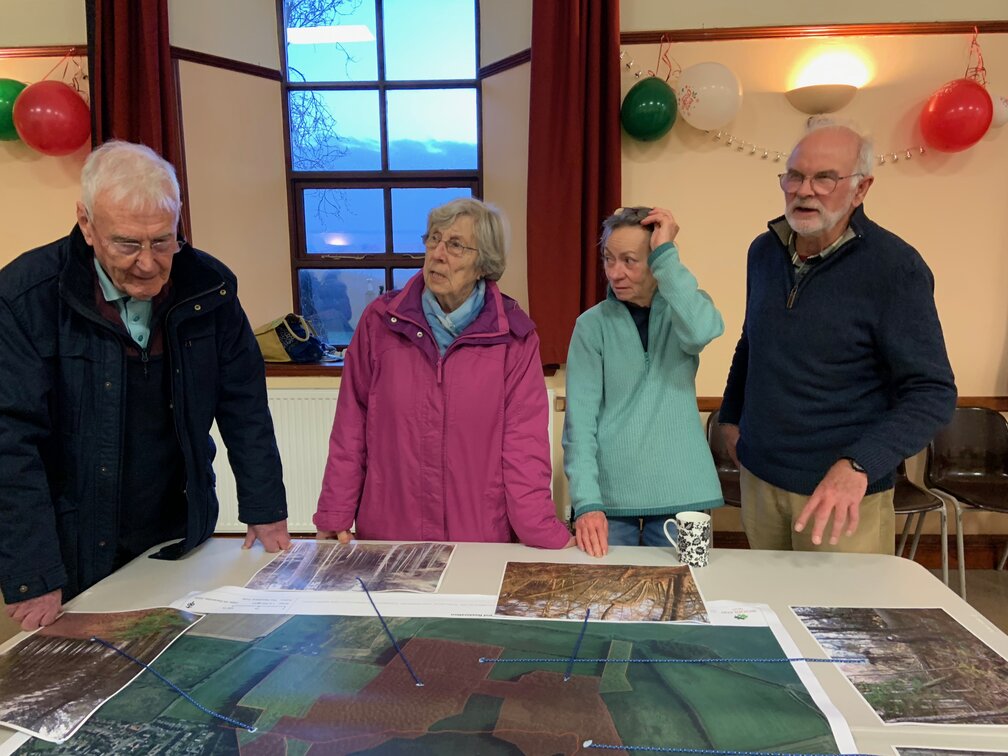
The future of Portmoak Moss has been a big talking point since December when Portmoak Community Woodland Group helped to organise a four hour drop-in session about what’s being planned.
Around 50 people came to Portmoak Village Hall on December 10th, to hear about the restoration project, which will see the removal of most of the trees and a return to peat bog. The plans have been drawn up by the Moss owners, Woodland Trust Scotland and Peatland Action, who are part of the government agency, NatureScot.
So many people love the Moss that we weren’t surprised by a deluge of questions about the wildlife, the trees and the future of public access. All these things will be affected. There will be different wildlife, different birds, more mosses and bog plants and changes to some of the pathways.
The restoration project actually began in 1999, when Sitka spruce was removed from the centre of the peat dome. It should never have been there in the first place but it was planted in the 1960s by the Forestry Commission, in response to a national timber shortage. In the event, the trees didn’t grow strong and were never harvested. Now many of them are blowing down.
Woodland Trust Scotland have been working to bring back what is a very rare, lowland raised peat bog. The Portmoak Community Woodland Group has also been doing its best, over several years, to remove any birch or pine saplings that tried to grow there, because of the danger that they would dry out the peat again. You can see the area where that has worked but elsewhere many of the trees have grown too big to pull out.
Peatland Action have advised that the best way to get the bog onto a sustainable footing is by tackling the whole site.
So, apart from sections round the fringe where there are trees like birch and rowan, the other, mostly non-native trees will go.
The current time-scale is to carry out the felling work next winter (2026) with the peatland restoration starting immediately afterwards. Access will be restricted during the main part of the works but will be restored - with some paths possibly taking new routes when we find out how the water table settles.
There won’t be much habitat left for red squirrels but there is plenty of new woodland in Kilmagad Wood and it contains some of their favourite foods, such as hazelnuts and acorns. Many woodland birds will be looking for new homes but there will be the right habitat for ground-nesting birds, like meadow pipit and skylark as well as waders, like lapwing and redshank.
It’ll be a few years before everything settles down and signs of the disruption fade away. But some changes will be fast, as different birds and insects, like dragonflies, explore the newly created pools of water.
We will give more updates, as we get them.


UPCOMING EVENT
Apple Day
Sunday, 4th October 2-4pm
Kilmagad Wood, Scotlandwell
Apple picking, apple juicing and lots of
home baking!
Recent news:
- In the pink? - 2 August, 2026
Latest from the B[L]OG:
- Winter 2025 - 18 March, 2025